Sajni Shreeji mujhne saambharya re
Raag Garbi · transliterated
The same kirtan in Gujarati
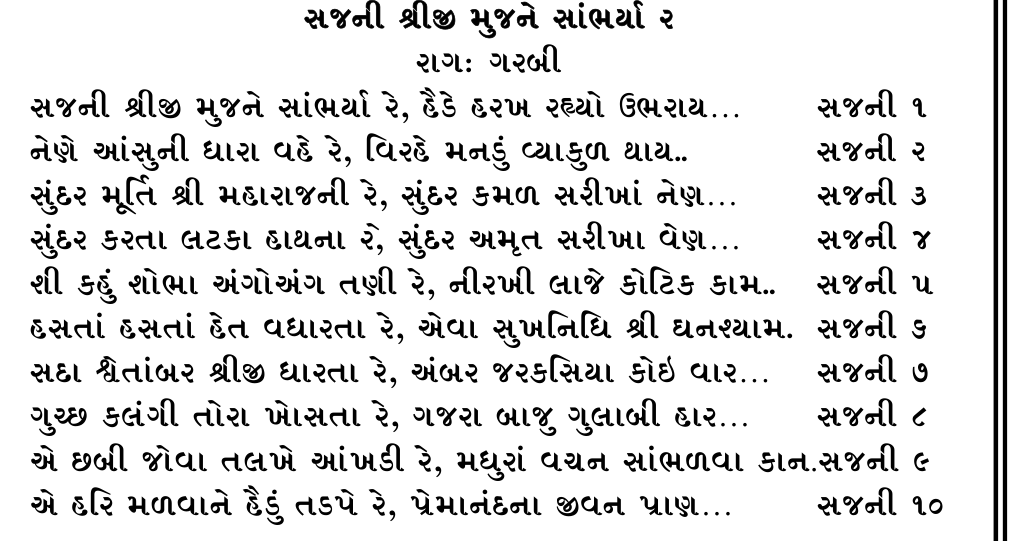
Scroll sideways to read the full line.
How and why this kirtan came to be sung
In the Samvat year 1886, after the departure of Shreeji Maharaj, everyone had drowned in an ocean of sorrow. Imagine the depression and sorrow of Premanand Swami. Even while Shreeji Maharaj was in the present human form, Premanand Swami could not bear to be separated from Shreeji Maharaj, so imagine when Maharaj left His human body.
A calf cannot be separated from the cow, a fish struggles without water and a child becomes restless without the mother. In a similar way, after the departure of Sheeji Maharaj, Swami’s sorrow, desperation and bewilderment led to him being unconscious. It is even said that Premanand Swami shed tears of blood. Having lived 14 years together, living separate from the beloved would be heartbreaking! Only Premanand Swami knew how this felt. “Only the wounded will know the pain of a piercing blow”. Who would find pleasure in living life after the departure of Shreeji Maharaj?
Premanand Swami, the one who loved composing music, stopped playing the sarangi instrument after Shreeji Maharaj left for heaven. He had used that particular sarangi, his favourite, to sing for Maharaj to compose the music and had sung an endless list of kirtans using it, yet he did not hesitate to leave it. He felt that his music was now out of tune; his life had gone, so what should he sing? What will he play? Who will he play for? He lost himself in trying to find the Sahajanand who gave him the strength to play music. Premanand Swami now stopped composing kirtans; the voice in his throat dried, and so did the ink in his pen.
Before the saints and devotees recovered from the departure of Shreeji Maharaj, the mother of the satsang - Sadguru Muktanand Swami - departed to Akshardham as well. Imagine what a satsangi child would be going through when both his mother and father had departed! Premanand Swami’s pen could not describe the pain of the separation with the one who fed him and played with him. The intellect of the brain cannot even imagine, let alone understand, what the beloved devotees’ sorrow was! Poet Dalpatram witnessed this true incident with his eyes and has narrated this story.
As time passed, during the month of Kartik celebrations of the festival of Hari Jayanti and later of Poonam were carried out and everyone had gathered in Vadtal. Acharya Shree Raghuvirji Maharaj requested Premanand Swami to bring along his sarangi to the festival. This was the first festival to be celebrated after Maharaj had left for Akshardham. More than twenty thousand people had come to the event in Vadtal. Acharya Shree Raghuvirji Maharaj sat Premanand Swami on a ten foot high bench and asked him to sing Kirtans. Swami replied, “After Maharaj left for the Dham, I have stopped singing and playing the instrument. I cannot sing anymore. The feeling is just not there.”
Acharya Maharajshree consoled him, “But Swami, your singing or playing instruments is not meant for pleasure of the senses. Your kirtans will bring memories and make the existence of Maharaj alive in the hearts of all again. For that reason, today I order you to pick up your sarangi and sing kirtans to take out all the grief building up within the devotees. Make our hearts lighter and get them attached to Shreeji Maharaj.’
Having said this, Acharya Maharajshree picked up the sarangi and put it in Swami’s hands. Swami was now compelled to sing. He started to tune his sarangi, ready to sing and bring back the memories of Maharaj. He remembered the way Shree Hari used to sit, sleep, wake up, hold sabhas, take His mare Manki for a ride, the festivals and places He went to, etc. In a low voice with long tune notes Swami started to sing out the sorrow in his heart. As the kirtan began, the listeners, especially new devotees, were shocked and wondered who this Swami was? The listeners’ hearts started pouring with grief. It cannot be said as to how they were feeling or imagining. Then again, there was happiness as one continued listening to it. One can appreciate the sense of happiness that Swami brought into the moment. Tears of happiness started rolling down all the listeners’ cheeks as they relived their memories when they were with Maharaj. When Swami meditated upon Shreeji Maharaj, he again remembered that Maharaj had left them. At that moment, Swami’s state began to get worse compared to the rest. The image of the Lord settled in every corner of his body. However, Swami deviated his mind and consoled himself for the betterment of all by continuing his duty set by the Acharya and meditated upon the Lord.
The meaning carried by the lyrics
In the first lines of the kirtan, Swami refers to all the saints and devotees present as his friends. He says that he remembers Shreeji Maharaj and cannot bear the separation. His heart is overjoyed because it can still remember Maharaj, but his eyes cry out floods of tears in pain because he cannot see or play with Him anymore. (1-2)
He then describes the form of Shreeji Maharaj, recalling the way He used to dress, the way He played with all the saints and devotees, etc. He recalls that portrait of Shree Hari, the delicate body with sparkling lotus eyes, the way He used to move His hands to express anything and His sweet nectar-like soothing voice. He cannot fully describe the beauty of Maharaj’s body parts, as they were incomparable and beyond description. Even a million kaamdevs (gods of seduction) combined would feel outshone by this beauty. Swami says, “O friend! My heart is eager to recall all this about Maharaj.” (3-4)
The beauty of Shreeji Maharaj’s body makes everyone fix their anxious gaze on Him! Shree Hari’s smile is everlasting and brings happiness to all that see Him. He usually prefers to dress in white clothes. Sometimes, He wore rich garments woven with shimmering colours, or at other times, He wore bright coloured clothes. His turban would have hanging beaded tassels, and would sport attractive flowers made as bracelets on His wrists. (5-8)
Swami says, “That is why my heart is anxious to meet the attractive murti of Sahajanandji. Day and night my desire is stung into this Murti. My ears are impatient to listen to the sweet speech of Maharaj. My heart is desperate to meet that Shree Hari as he is my life and soul.” (9-10).