Daatyo rahe ne chor dev na
Raag Dhod · transliterated
The same kirtan in Gujarati
Scroll sideways to read the full line.
How and why this kirtan came to be sung
Sadguru Brahmanand Swami was busy in the construction of the Muli temple. He was personally involved in all aspects of the work, to ensure that all was being done inaccordance with Shreeji Maharaj’s wishes.
At that time, a rich poet residing in Muli held a wedding function at his house and organised a grand ceremony, inviting the poet community and his wealthy friends from Kutch, Gujarat, Halar, Gohilwad, Sorath, Jhalawad, amongst other regions. Many youths blinded by ego of their wealth, attended the ceremony. The host knew that Ladudanji, one of their own and the most highly respected one amongst the poet community, had become a saint and was in Muli at present. He brought the guests to see the temple and meet Brahmanand Swami in the temple. Swami was not interested in showing off his abilities, but knew that these poets were arrogant in behaviour because they had ego based on their knowledge. Swami welcomed the guests in his small make-shift living quarters.
The leader amongst the guests asked six questions to Swami in an attempt to test his wisdom: 1. Who can make someone free from the desire of lust? 2. What is the name of the daughter of the ocean? 3. Where does the soul live? 4. Should I go for pilgrimage or not? 5. Who is the king of Gokul? 6. Who is the most affectionate for a devoted wife?
On hearing these questions, Swami smiled at the folly of these people purportedly believing themselves to be knowledgeable. Instead of giving them detailed answers, he carefully chose very short words that served as the answers: 1. Swami (ie: the Lord Himself or His saint) 2. Shree (ie: Laxmiji) 3. Saha (ie: together with the body) 4. Ja (ie: yes, you should go) 5. Nand (ie: Nand, the father of Krishna in Gokul) 6. Swami (ie: husband)
Then Swami said out of all the answers combined together to make up a name: Shree Sahajanand Swami and said that this name was the answer to their questions, both jointly and individually. Hearing this witty answer, the poets were amazed at the originality and execution of the reply that Swami gave and bowed to him in acceptance and recognition of him as truly being a master in their trade.
Hearing this, the wealthy youth blinded by their ego said, “Swami, you have so much incomparable poetical knowledge and wisdom, then why did you become a saint? You belong to the householder community as you have all it takes to become successful. Sainthood is for people unable to fend for themselves. It would be understandable if those who cannot get enough food, are very weak and have no skills of any type take up sainthood. However, you are a master in this profession. This knowledge that you have is the result of many years of dedicated education. Why are you not reaping the fruits of your efforts? You should be relishing yourself in the pleasures of good wine, women and wealth as you have a youthful age that is not going to come back to you once gone!”
In this way, the blinded youth taunted Swami about his humble sainthood. But Swami was a true saint; he had control over his senses hence did not get perturbed by this wayward talk. Instead, he thought about guiding these people out of their ignorance, using his simple, fluent yet very effective vocabulary to aggressively address these youth about the ills of being controlled by the senses. Words hissed from Swami’s mouth like steam from a geyser, and the ego of the youth started to melt slowly. Swami’s choice of words and explanation was particularly targeted at the youth so they related every word to their own individual lives and realised how true it really was. Slowly, Swami started to change from giving a sermon to composing and singing a song based on the same topic of being attentive towards the reality of this life. Not one, but eight verses were sang one after the other (two of which are here below), and the youth became shocked and felt ashamed at their behaviour and folly. Reality dawned upon them and they lost their affection to material pleasures. They fell into the feet of Swami asking for forgiveness and vowed to give up their addiction to women, wealth and wine, and change their course of life. Swami kindly introduced them into the Swaminarayan fellowship and initiated them as satsangis and taught them about the five vartmaans (vows). The youth promised to become good devotees and adhere to all the vows.
The meaning carried by the lyrics
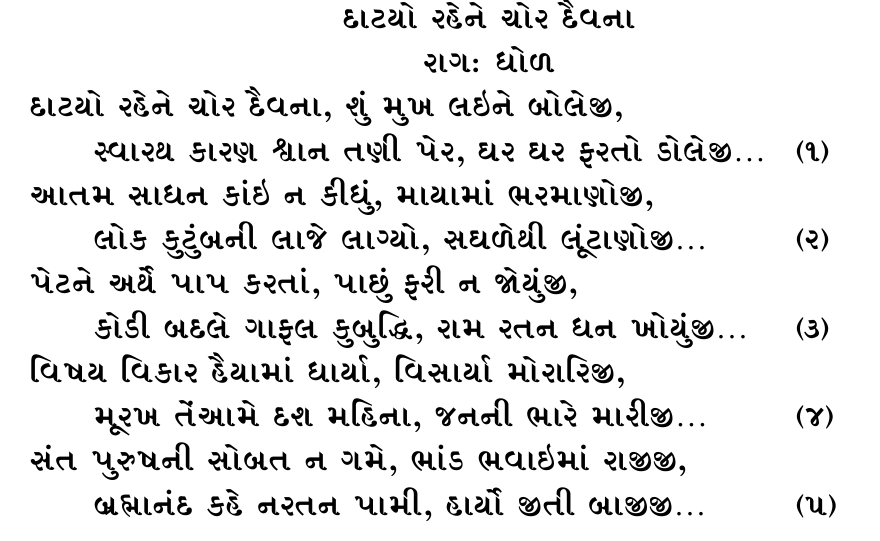
Swami used his sharp, accurate and effective vocabulary to address the youth and guide them out of their ego. He tells them, “You are thieves in the eyes of the Lord. You are not using the opportunity in hand in doing what He has sent you to do, meaning, make efforts towards obtaining salvation. You are all worthy of being buried alive as you have no face to show to knowledgeable people! When you were in your mothers’ wombs you cried for help, promising to worship the Lord, and were released and given this body to enable you to serve the Lord. However, you have backtracked on your word and instead have been bound in pursuit of women and wealth, both of which are mortal. You move from house to house in search of women like a stray dog. You will spend the whole of your life, and will take so many other births and yet not be satisfied by these pleasures. You have not done anything to feed your souls and give them peace. All your time is spent in serving your family and your personal ego, and your strength, youth and this time is all put to waste. Yet, you have not understood the purpose of life. (1-2)
He further whips them with sharper words of wisdom, “You are all sinner, as you have only thought about feeding your stomach, not your soul. You have never looked back and reasoned on your actions. The pleasures of the senses are worth a mere penny and you have given away your whole youth towards attaining that. In the process, you have lost an opportunity to serve the Lord. This Lord is the provider of all wealth and when served and worshipped, will shower boundless wealth over you”. (3)
He further advises, “Grain in a barrel may be countable, but the yearning of the human mind to attain pleasures cannot be quantified. Yet it wishes to attain all those pleasures and spends all its time in that, hence has no time to pray and worship the Lord.” Swami is not only addressing the guests in his hut, but his message is to all those people blinded by the ego of youth and power. He now becomes sterner as seen in his choice of words. “O fools, if you wanted to break your promise made while in your mothers’ womb, then why did you be a burden to your mothers, making them go through unbearable maternal pain for nine months while in their wombs? Instead of giving birth to sons like you, they should have given birth to rocks. Then it would be understandable as not much could be expected from rocks. Further, the rocks would have been useful in the construction of this temple!” (4)
Finally, Swami concludes the first verse by pointing out the destiny chosen by the youth, “O ignorant souls, you do not appreciate or like the company of saints. You are more engrossed with worldly entertainment and dancing and get comfort in them. You are no different from a senseless animal! This human body is the path to salvation and is not available even to the gods in the heavens. You have won the opportunity of getting this human body, but have attached yourself to it and to its relations, children, family and have spent more time in serving their needs. You have in your whole life never bothered to use your skills and intelligence to pray to the Lord or serve Him or His saints and devotees. O clever fools, what you consider as joy is a very futile understanding of the meaning and the reason of life. The true and lasting joy lies in the supreme Lord Himself; worship Him to attain and experience that pure joy and get blessed to fulfil the purpose of your life.”(5)
Raag Dhod · transliterated
The same kirtan in Gujarati
Scroll sideways to read the full line.
The meaning carried by the lyrics
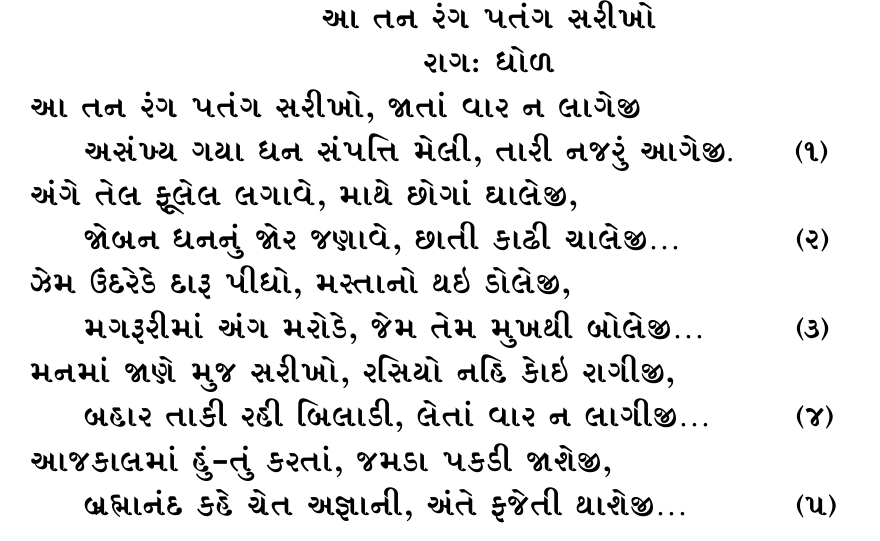
This is the third verse of this reknowned kirtan. Here, Swami has given human life its true status and explained clearly its fragile nature. This body is like a butterfly; though beautiful, it has a very short life span. It is said that even the great legendary warriors and kings, able to scrape stars from the sky with their bare finger nails, have not been able to avoid death. Many attain wealth and power, but how long does it stay? Valiant kings like Ravan, Sikander and Moonj have all come and gone. No one has beaten death nor succeeded in doing so. We can see this happening in front of our eyes. (1)
In the younger generation, many have demonstrated foolishness. They wore perfume on their bodies and wore turbans with beautiful peacock feathers and silver borders with hanging tassels. The current trend is to have various hair styles. Swami says that man is proud and rich and no matter what clothes or haircut he had he would show off by walking around with pride. For how long is all this going to remain? (2)
Swami explains using the example of the cat and mouse fable. A mouse, one of the very low forms of life, was living a goalless life. On top of this he used to drink alcohol, but how can a mouse have the capacity in his body to handle it? Under the influence of alcohol, no one is as mischievous and careless as him. He said and did what he liked. “There is no-one like me. I am strong and can take on anyone no matter what their size. Who am I scared of now?” What would he know, as he was under the influence of alcohol, that a cat was waiting outside ready to pounce on him and eat him in one mouthful. The mouse should have realised it earlier but he did not think. He did not realise the cat’s ominous presence. For the mouse a cat is an agent of death. The mouse had the power of wealth and beauty like today’s youngsters. The mouse was doing what he liked but with the mercy of the cat’s delay. However, when the cat raised its paw, he became nervous. Soon he was lifeless and devoured by the cat. (3)
Using this example, Swami explains that the young generation is compared to the mouse in the story. You are not in control of wealth, power and youth. Instead, you are under their control and then everything will be ruined and wasted. If you are an ignorant person and attain more happiness than you deserve, then you will end up doing something that you will regret. Being thankful and respectful is also a moral in the story. You should not boast about being rich and powerful. However, society sometimes becomes greedy and lurks after things that are bad for it, but later regrets follows when bad times come. We spend too much time thinking about what is ours and what belongs to others, instead of thinking about who we truly are. (4)
When today becomes tomorrow, the ushers (escorts) of Dharamraja (Yam Raaj) will take you away and place you before him where all your actions will be accounted for and punishment will be decided accordingly. At that time, you will regret your actions and you will be disgraced. (5)
So Swami is advising that all souls should remain alert. In order to achieve ultimate salvation (moksha) you should find the right teacher (guru) as early as possible to lead you onto the right path. The earlier this knowledge is obtained, the better it is.