Pragat thaya prabhu Chhapaiya gaam re
Raag Dhod · transliterated
The same kirtan in Gujarati
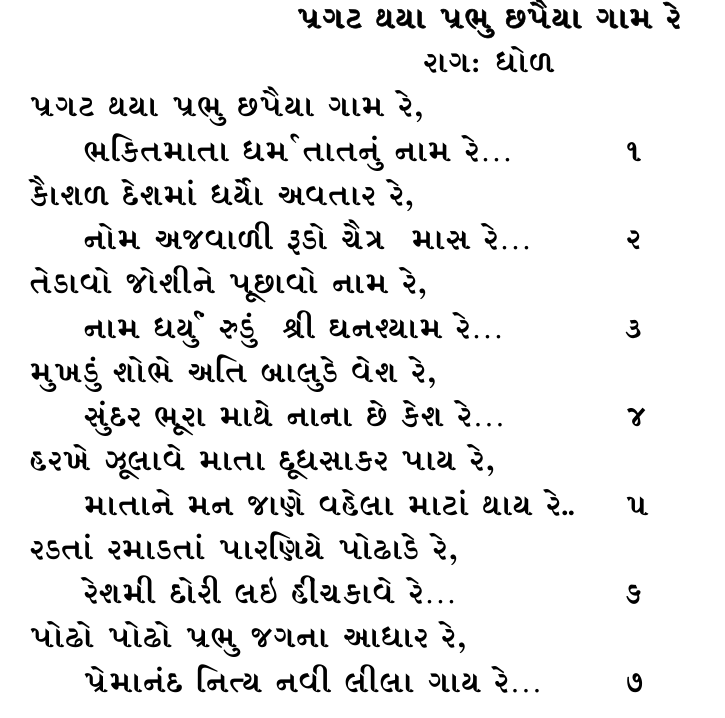
Scroll sideways to read the full line.
How and why this kirtan came to be sung
In the month of Ashadh, in Vikram Samvat 1870 Chaitra sud 6, in the town of Gadhpur (Gadhada), Shree Hari was present in a congregational assembly in the palace of Dada Khachar. Gunatitanand Swami, Gopalanand Swami, Muktanand Swami and other great saints were present. Dada Khachar, Mancha Khachar, Harji Thakkar and many other great devotees were also present in the assembly.
Then Shree Hari said “My devotees! Out of all the months, the month of Chaitra is the most auspicious month. For any religious teachings and festivals that take place in this month, the blessings and goodness received are increased many fold. This is stated in our Holy Scriptures. In this month many yagnas (religious ceremonies) and other auspicious activities and events are conducted to please the ancestors and rid the atmosphere of evil spirits. Just as gold is made more attractive when beautiful ornaments are made from it, this month is further made auspicious by the birth of Lord Shree Ram on Chaitra Sud Navmi. Hence, in two days, on the day of Chaitra Sud Navmi, we should celebrate the birth of Shree Ramchandraji, and sing kirtans in His praise.
On hearing this, Sadguru Gunatitanand Swami remarked, “Maharaj, Your birthday is also on this day, isn’t it? If we celebrate Your birthday, we will also automatically celebrate Shree Ram’s birthday.”
On hearing this Shree Hari remained silent. However, the thoughts of Swami made Shree Hari smile and all the saints understood that the silence of the Lord was a sign of His agreement to that. The elder saints and devotees of the Lord decided to celebrate this day with a festival called ‘Shree Hari Janmotsav’, the birthday on this earth of the cause of all the incarnations. Thereafter, Muktananand Swami said, “After 2 days, on the ninth day, it is the birthday of this supreme Lord Sahajananand Swami. We will perform all rituals to celebrate this birthday with pomp and glory. Any saints who can compose kirtans for the celebrations should do so to sing them on the Lord’s birthday.”
On hearing this, Maharaj’s faithful poet devotee Premanand Swami thought this was a great opportunity of joy and to spread love and devotion. His heart was full of devotion for Maharaj. He liked this opportunity and decided to take up his chance. It was as tasty as giving an enjoyable medicine, and as easy as running downhill. He wasted no time and was determined to compose a kirtan. He had been singing devotional songs about the childhood and lifetime of the almighty Lord and this gave him unlimited happiness and joy.
Other poet saints also composed kirtans within no time. The hearts of saints who had no previous knowledge of music or poetry and had not learnt any poetic languages such as Pingal, suddenly became musically orientated and started to compose and compile melodious lyrics full of love, devotion and passion for the Lord.
From then onwards, on the ninth day of Chaitra, at 10 O’ clock at night, the festival of Shree Hari Janmotsav (the birth of Shree Hari) is being celebrated. The auspicious arrival of the Lord enabled many saints and devotees to compose, recite and compile such wonderfully written kirtans about the Lord’s birth and presence on earth. Fellow devotees of the Lord! Let us celebrate the birth of the Lord together and receive the Lords blessings.
The meaning carried by the lyrics
In the residential palace of Dada Khachar in Gadhada on Chaitra Sud Nom, a festival marking the birth of Shree Hari (Swaminarayan Jayanti) was celebrated. During this celebration, Sadguru Premanand Swami was singing and saying that the arrival and presence of the Lord on earth was for His devotees. He manifested as the son of Dharmadev and Bhaktimata in the town in Chhapaiya in Vikram Samvat 1837 in the month of Chaitra on the ninth day at night. (1-2)
The baby was named by Markandeya Muni, the family astrologer. Premanand Swami tirelessly admires the beauty of the baby. The face of the Lord is glowingly attractive. On the head of Ghanshyam there was an eye-catching golden crown. He has short brown lovely hair. (3-4)
Bhaktimata is swaying Shree Hari in His cradle. She is feeding Him milk sweetened with lumps of sugar and wishes that He will grow up quickly. Whenever the baby Lord cries, Bhaktimata carries the Lord and gently puts Him in His silken cradle and sways Him whilst singing sweet lullabies to make Him go to sleep. (5-6)
Swami says he gets endless joy in singing this kirtan about the childhood leelas of the supreme Lord’s human form. This Lord is the one who does new leelas all the time to mesmerise the other incarnations. (7)