Harijan saacha re je urma himat raakhe
Raag Garbi · transliterated
The same kirtan in Gujarati
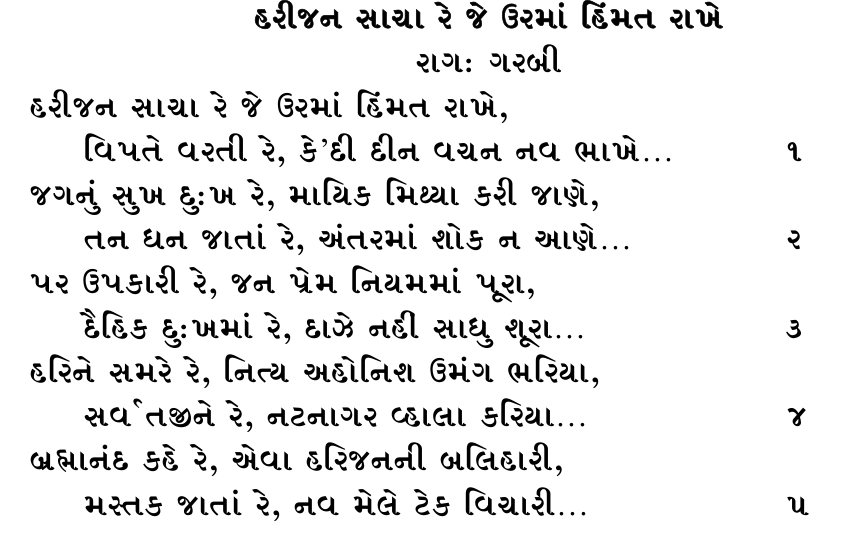
Scroll sideways to read the full line.
How and why this kirtan came to be sung
Rupabhai of Kidi village was working in Bhavnagar’s Maharaja Vijaysinhji’s palace as his personal secretary. The king showed lots of affection for Rupabhai which the rest of the ministers were jealous of. These ministers were always finding ways to belittle and ridicule Rupabhai in front of the king.
One of the ministers who Rupabhai had favourably appointed to a high post in the kingdom, started back-biting to the king. “You praise Rupabhai so much and, you say that he will never disobey your wishes or orders. To prove whether he obeys all your wishes and commands or not, ask Rupabhai to be served liquor in your royal court tomorrow. If he doesn’t disobey your order in full court then you can whip me five times.” Saying so, he instigated the Maharaja.
Smoke that has been created from a fire tends to become part of clouds and turns to rain and extinguishes the very same fire. Similarly, a wicked person does not appreciate his well wishers; he destroys and humiliates the persons through whom he gained the high post or rank. The minister that Rupabhai had done a favour on was going in the direction of accusing & destroying Rupabhai’s reputation. The minister was confident that Rupabhai would accept beheading but never accept liquor.
The next day, drinking of liquor was going on in the court, and Maharaja ordered one of the servants (obviously these were persons of lower caste) to pour liquor for Rupabhai. Rupabhai refused to accept it, and the servant said to the king, “Rupabhai is like your friend, he will not accept from some low caste like me, but will accept if you offer to him!” Saying so, he added more insult to injury. Enraged, the Maharaja stood up taking the liquor glass, and ordered Rupabhai to accept it. Rupabhai still refused. On the side sat the ministers. They exclaimed, “Rupabhai! You’re insulting the Maharaja of 1800 villages in full assembly. In respect of the Maharaja please accept at least a little of the liquor”.
Rupabhai fell in a religious quagmire and ethical dilemma. He said ‘Maharaja! I have taken a vow in front of Swaminarayan Bhagwan not to drink liquor. Whilst my head is over my neck, I cannot drink it.” Saying so, he removed the sword from its scabbard and handed it to the maharaja and said, “But to honour your command, I offer myself. Behead me then pour liquor in my neck. Your respect will be maintained and my vow will be conserved as well.’ Hearing this, the Maharaja sat in his seat, defeated.
The wicked minister said, “O Maharaja, see, I have proven myself. You were praising, but Rupabhai has insulted you in front of the full court. Now will you believe me?” The minsters really instigated excitement on the maharaja, and in fury the maharaja ordered Rupabhai to leave the kingdom. The vile minister was very happy at his achievement and trickery; this is generally seen with dishonest people who front a humble face.
Rupabhai was from a very innocent family. He did not know where to go and what to do? So the whole night he sat down and prayed to God for guidance. With his divine power, Shreeji Maharaj saw what had happened and said to Brahmanand Swami, “Rupabhai is in trouble and distress. So please compose a song that will give him courage in this time of difficulty and send it to him”. Brahmanand Swami composed a song of four pads and sent it to Rupabhai. Each and every word in this kirtan spelt out audacity and encouraged Rupabhai (and all satsangis in similar circumstances) to abide by the teachings of Lord Swaminarayan.
The meaning carried by the lyrics
Swami has composed lots of songs portraying the value, worth, power, importance, consideration and reckoning of courageous devotion. A true devotee is one who has feelings to offer, devote and dedicate his life to God, is knowledgeable and is a true warrior against evil deeds and thought. He is absorbed by pure notion, offers his wealth to God and is pure in thought, actions, and speech. He will never go against his faith or lose courage in times of trouble and distress, even if he has to give up his life. When injustice is being done against him or insults are hurled towards him; he will never break the vows and promises he’s made towards his God. This is the true devotee. (1)
A true devotee is one who has gained from the company of true saints and regards this world’s happiness and distress as irrelevant, destructible and finite. A really patient servant of God is as ready to bear inglorious troubles as those which are honourable. A brave man can easily bear with contempt, slander, and false accusations from an evil world; but to bear such injustice at the hands of good men, or friends and relations, is a great test of patience. He who has faith has an inward reservoir of courage, hope, confidence, calmness, and assuring trust. All that will come out well - even though to the world it may appear inconsistent. Even if he and his relatives lose wealth or any other luxuries, he does not mourn over it. (2) A true devotee is one who finds joy in helping others without any selfish desires, follows all the rules with love and never grieves or laments on any bodily illness he’s got. (3)
All day and night he happily chants God’s name. A devotee who has detached himself from luxuries and relatives and has brought himself to love God is considered to be a jewel in the Lord’s crown. (4)
Brahmanand Swami congratulates such devotees, who will sacrifice themselves 100’s of times to fulfil the vows and promises they have made to God without fear of anything. (5)