Jagat mein jeev na thoda
Raag Laavni · transliterated
The same kirtan in Gujarati
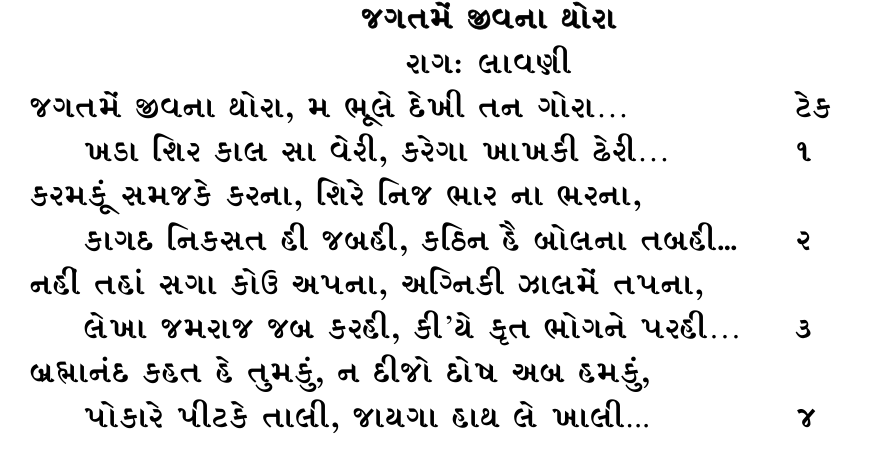
Scroll sideways to read the full line.
How and why this kirtan came to be sung
Being constantly in the company of high quality austere saints, Dada Khachar’s material sense desires have become rootless. Enjoyment of worldly affairs has become pointless and getting married is now considered a sin. Dada Khachar of such a high calibre is now advised by Shree Hari, “Dada! You will have to marry.” Dada politely replied, “To anyone who comes to You, You ask them to become a saint. But how come You want to push me into this sin of attachment.” And Maharaj replied, “No Dada! It’s not that, but you are the only son, the light, of the Abhel Khachar generation and that’s why I don’t want you to turn off the lights of this generation. Dada, I understand your non-desire for worldly affairs, but anyhow you still have to get involved with the household (married life) to rule the kingdom and ensure the rule continues.” Wiping his tears, Dada said, “If I do not obey your order, then I will be considered a demon. That means I have no choice but to accept your request.”
In a short period of time, Dada was then engaged to Jasuba of Bhatvadar. The formal wedding rituals preparations were made and they gave a party to the whole village and were ready to take the wedding procession to Bhatvadar. But due to the atrocity, jealousy and opposition of Jiva Khachar (Dada’s uncle), females were not allowed to join in the wedding procession. The question arose then that who would sing the wedding songs in the procession. So Shree Hari using his powers of being able to do the impossible, ordered saints who have no interests in worldly affairs, women or wealth, to join the wedding procession. This is the only occasion in history that saints have officially attended a wedding. The ascetics who consider religious comfort in obeying God’s command, put their big turbans on their heads, bags on their shoulders and gaumukhi (mala sheath) in their hands and began to sit in the groom’s cart. But Shree Hari advised only the eight poet saints to sit on the cart of the groom. Lord Shree Hari became the rider of the bullock cart of his dear Dada Khachar. What an amazing unity of the three individual forces! The supreme Lord as a cart driver, saints forming the groom’s side, and a topmost devotee like Dada being the groom, was a splending sight. Everyone devotedly joined the procession, a special event which is written in golden letters and remembered in Maharaj’s life history. The procession thereafter took off.
Can the great ocean of love in Brahmanand Swami stay calm without being joyful on witnessing this divine sight? Brahmanand Swami considered enjoyment of wealth, children and women and other material attachments to be worthless, hence based on his own character and as a warning of alertness to Dada and to other householders, composed and sang this instructive song with sharp lyrics like a whip dipped in lemon, chillies and salty water.
The meaning carried by the lyrics
Swami is saying, “O ignorant souls! You have a short time to live in this world. Yet you are still proud of your beauty and forgetting your original position? Do you know that the eternal enemy in the name of Kaal (death) is hovering over you? Just like a farmer hovers 3 times a day over melons grown in the farm and brings an end to the ripe melons, in the same way death (time) will bring an end to this good looking yet temporary body and turn it into ashes once your time is up. (1) The path of karma (action) is unchangeable. The law of karma is difficult and confusing to understand. ‘Karma pradhan visvakari rakha, jo jash karaai so tas fal chaakhaa.’ The whole cosmic evolution runs abiding by the law of karma. It’s fruitful to follow the path of karma as it will lead you to the light. No one except the Lord and His topmost devotees can change the fruits of actions, and that is a fact. We may question what is this karma (action)? In the simplest language, karma means eating, drinking, bathing, washing, listening, smelling, touching, ie any action from birth to death. All these physical and mental actions are karma. There are 3 different divisions of karma.
The first one is kriyaman karma, second is sanchit and third is prarabdh. From the time you wake up till you go to sleep or from birth to death, all the actions performed between these times are known as kriyaman actions. The fruits of kriyaman actions are rewarded straight away, for example, if you are thirsty, you drink water and by drinking water you have quenched your thirst straight away; or if you swear at someone and he slaps you, you have immediately received your fruits of kriyaman karma.
Secondly, those kriyaman actions which are not fruitful immediately are bundled together and are called sanchit karma. For example, if you sat an exam and until you haven’t had the results you are thinking whether you passed or failed, that is called sanchit karma; or if you have harassed your parents in your youth or at young age, then that karma will have to be suffered by you in your old age through your own children, so this means the karmas are gathered together.
Thirdly, when time comes later on to reap the fruits of sanchit karma that is called prarabdh karma. For example, someone who suffers from critical illness for 10-15 years prays to the Lord asking when will he be relieved from this suffering? Despite pleading from the bottom of his heart, the suffering does not come to an end which means he’s suffering from his prabadh karma. All these 3 types of karma are to be suffered by each and everyone. We happen to see lots of people who are paralytic, deaf, dumb and lame etc, these are not wishes of God to create them in this way but it is their karmas that give them their body accordingly. That’s why Brahmanand Swami explains, “If you do any karma it should be done with care and attention. Any karma that is done by ignorance has to be suffered for.” (2)
According to the law of nature, at the time of our death, Chitragupta, Vichitra and Chitralekha who witness our karma will present them to Dharma Raja (Yamraaj). If you have done bad deeds, you will have no say; therefore you must be careful in doing good karmas. When Dharma Raja weighs our karmas, there will be no ifs or buts because his 140,000,000 servants (yamdoots) are ordered to punish us and we have no say in it. Having done bad karmas we will have to suffer in the 84 hellish pools and be baked under the heat of 12 suns. When Dharma Raja looks at our account and undertakes an audit on our bad deeds, there is no way out but to suffer them through. (3)
As a guide to blinded souls, Brahmanand Swami says, “O fools! For your benefit I advise you not to do bad deeds. If you do not take this good advice, then do not blame me as I have warned you. I am telling you the truth; your relatives, friends and wealth will not come with you at your time of death as you will go alone empty handed. All our good deeds and sins done are already recorded, so we will have to go alone and any good and bad deeds we have committed will have to be suffered. There is no doubt in that.” (4)