Dhiraj dhar tu aree adheera
Raag Dhod · transliterated
The same kirtan in Gujarati
Scroll sideways to read the full line.
How and why this kirtan came to be sung
Ratansinh was the royal courtier of Ratanpur village in Paldhari state in Rajkot. He had his sister Kusum Kunvarbaa married to the King of Morbi. But she could not bear a child, and her husband remarried again. When the second queen gave birth to a prince, there was happiness and rejoicing in the kingdom. Every woman wishes to be a mother; Kusum Kunvarba became sad as she did not have a child.
Ratansinh was a skilled horseman and enjoyed the various sports of riding horses. He used to play the horse games with a spear in his hand. Once the prince of Morbi got interested in the game and went towards the horse. The horse suddenly jumped and the spear in Ratansinh’s hand pierced the neck of the prince by accident and the prince died.
The kingdom was suddenly surrounded by sadness and grief. Ratansinh got scared and ran away. He was accused of the prince’s murder. He was really confused. After hearing about the power of Devanand Swami he went to Muli. He explained his trouble to swami. Swami gave him comfort by explaining to him about forbearance and patience and requested him to go back home. Ratansinh was scared if he went home he would be caught and would be sentenced to be hanged. Hearing this swami decided to go with him to Ratanpur.
On the outskirts of the village Ratansinh saw a horseman approaching, and he got very scared. Swami comforted him and said that, “He has not come to catch you, but has come to give you good news”. The horseman came near and handed Ratansinh a leaflet with red letters on it which read, that Kusum Kunvarbaa had given birth to a prince, and Ratansinh’s crime had been forgiven and that the village of Ratanpur has been given to him as a gift.
Ratansinh understood that instead of being hanged and being given the village as a gift was all the fruit of blessing of Swami. Ratansinh took the vows of the sampraday, from Swami and became a devotee of Shreeji Maharaj. Ratansinh donated 100 acres towards construction of Muli temple. On this occasion Devanand Swami composed a song, consoling and comforting him and explaining to him about having upmost faith in God.
The moral of the kirtan is that in life whatever challenges you come across, especially in difficult times, you should try to spread the sweet smelling nectar of patience.
The meaning carried by the lyrics
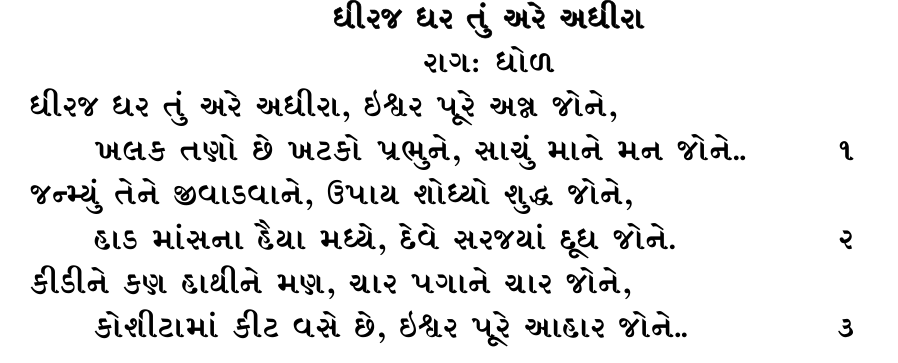
In this verse, Devanand Swami explains that we should have faith in God as He is the provider of all things, and live our lives being happy and understanding why we need to be patient and with forbearance. (1)
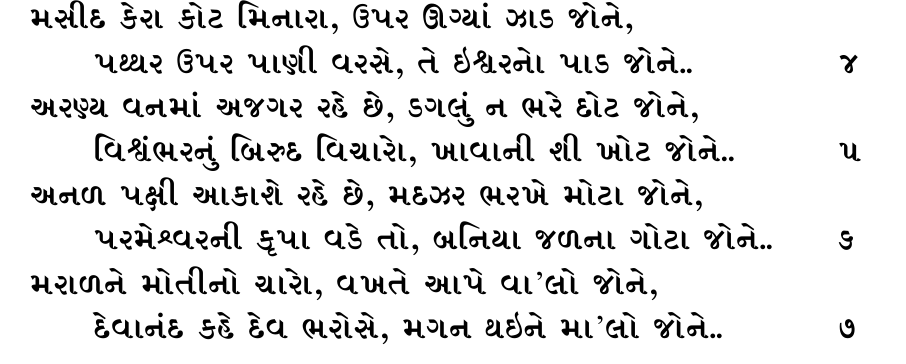
To those who God has given teeth, he has also given food. He who has created this world has also by default taken the responsibility to provide for and preserve it. (2) Devanand Swami is giving us examples from our daily lives and illustrating God’s power in providing for the universe. He is showing us the miracles that God has performed. For example, God provides milk in a mother’s chest for the baby, small seeds for the ants, leaves on branches of trees for the elephants, grass for the cattle, ready food for the embryos still in cocoons, food easily obtainable near the water for the swami to feed on, food and water for the growth of the bursting plants from the cracks of the ground, among others. (3-4)
He gives us a proper idea of the creation of this universe. In the Lords’ kingdom, even the python is very well fed even though he has no feet. He provides food for the spider that builds a web in the corner to sit in. God himself created this universe; He cares and is concerned for all living in it. After all this, why should we lose faith in Him? (5)
Under His control, clouds form and fall as rain; with His blessings, we obtain everything. In His eyes we are all equal; He gives us the right gift at the right time. (6)
That is why man should always include patience, forbearance and faith in his bhakti (devotion), leaving the rest to God. The bhakti we do is never wasted; whatever we have sown will always grow. What we throw away is what we lose. (7)