Vandu Sahajanand rasrup
Raag Garbi · transliterated
The same kirtan in Gujarati
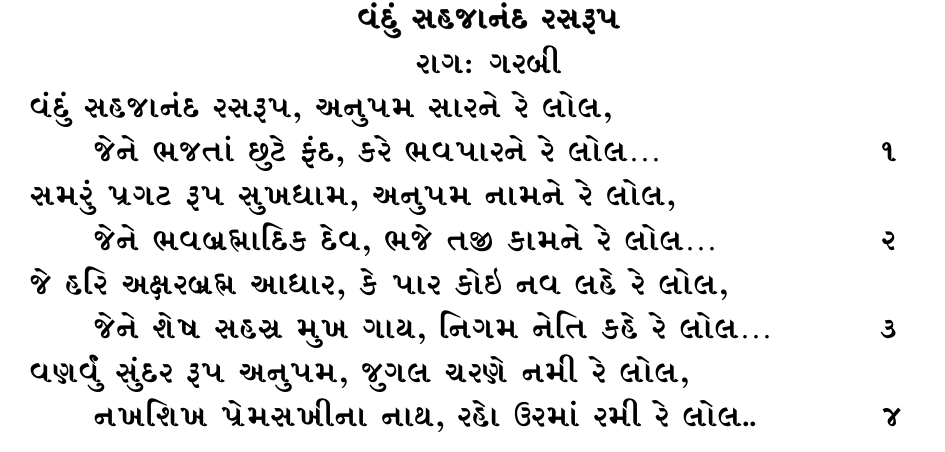
Scroll sideways to read the full line.
How and why this kirtan came to be sung
Think of a person in the Swaminarayan sect whose heart is filled with the fragrance of love, and whose inner self is filled with musical notes overflowing with devotion. The name that immediately comes to mind is that of the devoted Premanand Swami, who has amicably filled the role of pure love and devotion which Radhaji played while with Shree Krishna Bhagwan.
Swami was always yearning to be with Maharaj. Every breath he inhaled had the fragrance of Maharaj’s name on it and every breath he exhaled had the sweetness of Maharaj that spread to all devotees. Whenever they were not together he would always remember and visualise the moments they shared. When Shreeji Maharaj was swinging on the hindola (swing tied to a tree branch), serving saints while they were eating, explaining the inner philosophy of the true religion to His devotees in a congregation and also, whilst having a bath with the devotees in the River Ghela, wearing plain white garments or colourful clothes adorning rich jewellery and garments on His body, or whether He was performing His divine or human plays. How would Premanand Swami, a person who was fond of Maharaj, be able to stay without making a kirtan based on what he saw? His pen would inscribe the plays and all its characters involved in actual perspective.
On the fourteenth day of the dark half of the month of Maha (vad Chaudas) in Samvat 1880, Sahajanand Swami was seated facing eastwards in front of a congregation in Dada Khachar’s courtyard. He had worn rich white woven garments on His body. A new tulsi mala (rosary) decorated His neck. Tassels of yellow flowers hung off His turban. A colourful garland from different flowers hung from His neck and added more beauty to His attire. Shree Hari was explaining the details of His divine abode Akshardham, making gestures intricately with both His hands. Premanand Swami was staring at Shree Hari in an unmoved admiration of His beauty. He concentrated so much upon every detail of Shreeji Maharaj seated in front of him that His image was carved into Swami’s heart. Swami’s affability and devotion started overflowing, so he stood up and walked towards Shree Hari. He opened his hands and started dancing, composing and singing the following kirtan. In Vachnamrut 48 of the second chapter of Gadhada, which is about this congregation, Maharaj has praised the devotion of Premanand Swami after hearing this kirtan and stood up to embrace him. He blessed His parents and promised that anyone who sings this song everyday shall be free from the mortal body and shall be able to live an unattached life on this earth.
The meaning carried by the lyrics
Premanand Swami bows down to Swami Sahajanand’s murti, as it is full of all the nine celestial tastes. The Lord’s murti and His name is incomparable! He is above merit. If one meditates upon Him, one can be disengaged from the five attachments (panch vishay) and cross the ocean of life by His mercy. (1)
Swami meditates upon Shree Hari in every way because His beauty is the residence of bliss. All the incarnations of Bhrama and the demi-gods pray to Him. (2)
Shree Hari is the authority of Akshardham (His celestial abode). Therefore, no one can describe in detail the knowledge, manner, etc of Akshardham and of Himself in the way that He can. Shesh Narayan (the serpent god who holds the earth on his head) continuously sings praises of the Lord with his 1,000 mouths, yet he cannot describe the Lord in full. Sacred scriptures hold the oldest knowledge, yet they cannot describe the magnitude of His greatness. (3)
The wonders and gaiety of Sahajanand Swami described in this kirtan is due to His blissful gaze on Swami. Premanand Swami bows down to His feet and wishes to share this moment with all and describe the murti of Maharaj in full detail for the remembrance and salvation of all human beings. “O Lord, the account that I make from Your toe to the tuft of hair on Your head is of what You exactly are and what I see right now. I urge for that glorious appearance to remain within me forever, blessing my eyes and glorifying my soul.” (4)