Sarve sakhi Jeevan jovaane chaalo re
Raag Dhod · transliterated
The same kirtan in Gujarati
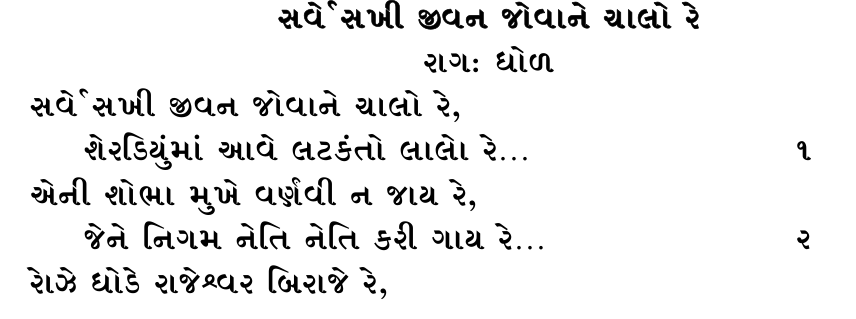
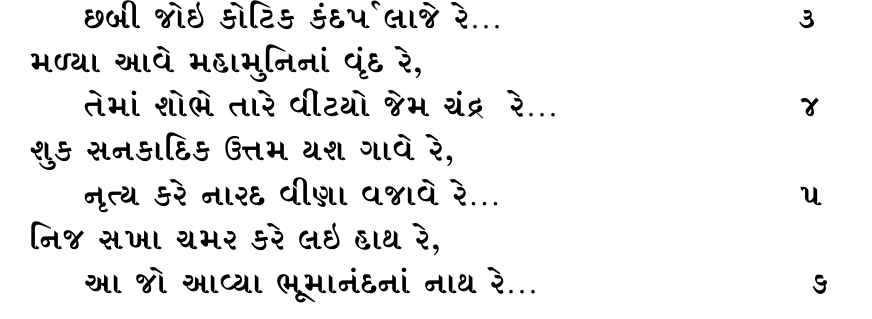
Scroll sideways to read the full line.
How and why this kirtan came to be sung
Once, Shree Hari arrived in a holy village named Agatray, in the green and beautiful district of Saurashtra to celebrate Janmashtmi, the birthday festival of Lord Krishna. The festival was celebrated with much enthusiasm, happiness and affection by the village’s foremost devotee, Parvatbhai. After the festival, Shree Hari and the saints stayed there for a few more days. At that time, Manavadar village’s Govindram Bhatt, brother of Mayaram Bhatt, came with his entire family to Shree Hari for the Janoi Sanskaar (rite of giving the sacred thread) of his son Narayanjibhai. To give the sacred thread under Vedic rites to a Brahmin’s son involved a big ceremony with a lot of financial cost. The Lord knows about the financial capacity of all. Understanding Govindram’s circumstances, He mercifully said, “Do not despair, take Narayanjibhai around in the village in a procession of aptly decorated floral chariots. I will also join in the procession, riding my ‘Roza’ horse. This is an accepted alternative to the Vedic requirement and all your wishes would be accomplished.” Aahaha! See how much Maharaj loves His devotees! What a display of compassion!
Today, the eternal Purna Purshotam Bhagwan, owner of all the abodes, has destroyed a devotee’s grief and is visiting the streets of Agatray village on a floral chariot. The environment has become auspicious in all four directions. The emotional joy overflowing in the hearts of devotees present cannot be controlled. Thousands of men and women are witnessing the bliss of the benedictory ceremony, considering themselves as fortunate. Shree Hari is welcomed with gold and silver petals. Various sorts of gifts are offered by His disciples who are desirous of salvation.
In this way, all people in Agatray’s streets were like waves in an ocean of joviality and merriment. How could a poet saint like Bhumanand Swami witness this without composing a song? He could not refrain himself; here is a glimpse of the jovial shower of devotion by the great Bhumanand Swami.
The meaning carried by the lyrics
My dear companions! Let’s go and see the gait of the Lord coming in our streets. (1)
Even the Vedas have difficulty in describing Him and therefore how could we describe His beauty with our mouths. (2)
Even the glamour of countless cupids would feel bashful when they see the seated Ghanshyam on the ‘Roza’ horse. (3)
Just as the moon sits in the middle of stars, Shree Hari glamorously sport Himself in the midst of saints (munis). (4) At the same time, in the heavens, Naradji (the Lord’s messenger) is playing his musical instrument, the lute; and ascetics such as Shuk and Sanak are singing praises of the Lord’s excellence. (5)
Bhaguji, Maharaj’s friend and devotee is fanning Him with a fly- driver. Bhumanand swami is confirming with respect and affection that the Lord of the universe has come on this earth. (6)