Saacha sant ne upma shi aapiye re
Raag Dhod · transliterated
The same kirtan in Gujarati
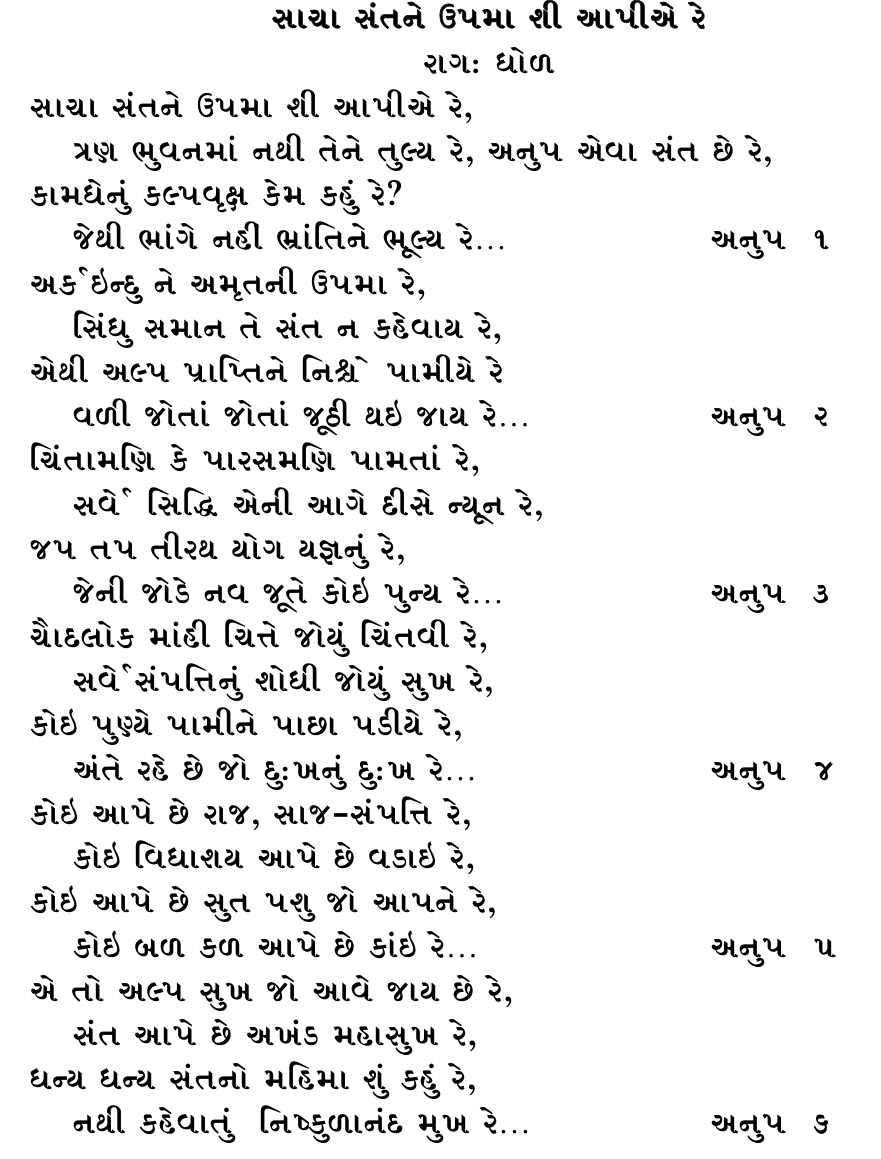
Scroll sideways to read the full line.
How and why this kirtan came to be sung
One day, Shreeji Maharaj was seated in an assembly of saints and devotees. At that time, Kapileshwaranand Swami returned with some saints from a preaching tour of some small villages in the countryside. Maharaj asked them about the progress of religion in the villages and if there was any development in the livelihood of the people. Kapileshwaranand Swami replied, “Maharaj, we face a lot of resentment from bogus ascetics. They have spread out to all villages and preached their false doctrines and the humble innocent people are being misled. We preach the true religion as established by Yourself so their baseless doctrines become transparent, hence they oppress us. Many of our saints have also been physically beaten by these rogues. However, we are not disturbed by that; what is more painful is that the innocent people cannot understand the reality of these rascals. They do not differentiate them from us, and are being misled into turmoil by these selfish souls. We are agonised by that. If we go to the king to complain about this situation, he shuns down our request saying that he is not interested in giving justice when cows are fighting.”
Hearing these details of the plight of the saints and the situation of the satsang, Maharaj turned to Muktanand Swami and other senior saints and lamented, “Swami, these true and dedicated saints do not even think of harming the smallest of souls. How can we portray these merciful ambassadors of our religion to these naive people? If the people have sight of such saints, all their ill acts are destroyed; all sins are destroyed by touching them. Saints have virtues like calmness, forgiveness, satisfaction; how will the people understand them correctly?”
Nishkulanand Swami was also seated in the congregation and in reply to Maharaj’s question, composed a song “Sant lakshan kahe Hari het shu re”. In it Swami mentioned all the qualities of true saints therein. He composed four verses of this kirtan, the third one of that being the following verse:
The meaning carried by the lyrics
Swami says “There is nothing in these three worlds (heaven, earth and hell) that can be compared with true saints. Even the much desired sacred cow and tree cannot be equal to these saints since they can only fulfil material desires, while the saints can destroy the ill thoughts of the soul and guide us through endless quagmires. Saints can give never-ending happiness and destroy any doubts about the supremacy of the present Lord.” (1)
“Even the sun, moon, nectar and the ocean, though very powerful, cannot be equal to the power of the true saints. The mentioned four elements can only give quantified or limited joy. Even the wishing stone, and the gods of wealth and fame pale against the saints. Saints can transform an ordinary soul into the status of a god, meaning they can empower him to be a beneficiary of the joy and greatness of the Lord.” (2-3) “Even the fruits of chanting, austerity, hermit life and performance of sacrifices are less that the rewards of having the sight of true and holy saints. Any one of these vehicles may enable one to attain one of the superior worlds of the gods where residence is for a finite term and at the expiry of that time one has to fall back to this world. True saints, however, can lead the soul to Akshardham from where he will never fall again.” (4)
“Other ascetics may empower a person by gifting him with a kingdom to rule, wealth, wisdom valued in this world, respect, fame and power. They may even give sons or peace to families, but what is the need of these if it distracts them away from eternal peace? This happiness is like the shadow of a moving cloud or puff of smoke that will move away by the force of a mere gust of wind.” (5)
“That is how temporary the joys of this world are; they come and go. True saints give eternal joy that the force of time cannot destroy, by enabling even the smallest of souls to know the glory of the Lord. The greatness of these saints cannot be quantified by anyone or compared to anyone or accurately portrayed in detail by anyone.” (6)