Hari haiya na haar chho
Raag Kaafi Garbi · transliterated
The same kirtan in Gujarati
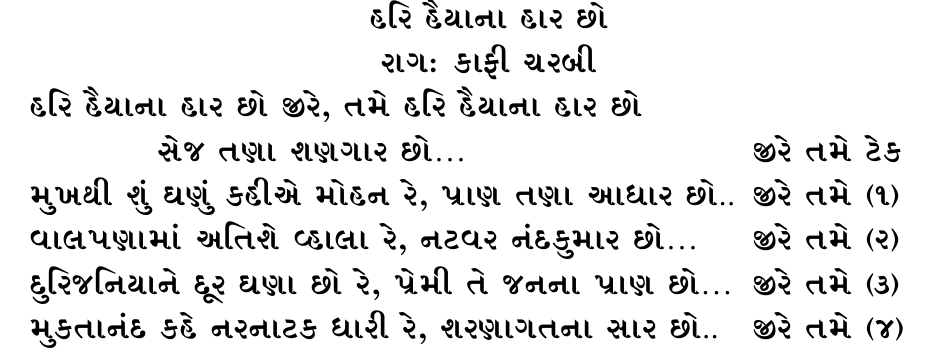
Scroll sideways to read the full line.
How and why this kirtan came to be sung
Muktanand Swami arrived at Gadhpur from Vadodra where he had achieved an overwhelming victory in the literary debate with highly intellectual priests from all over, whose knowledge was considered nearly equivalent to the scholars of Kashi. A welcoming ceremony was organised and Shreeji Maharaj highly praised Muktanand Swami for the achievement. This made Nirvikalpanand Swami and Haryanand Swami jealous and in resentment they said things they shouldn’t have said. Looking at their discourteous behaviour, Shree Hari felt poignant, and said with immense sadness, “Why is there so much rage and jealousy for such a great saint whom we consider to be our spiritual teacher (Guru)? Why should anyone wish equality with him! If they have wrath, anger, jealousy and competitiveness within themselves, breach of respect between young and old people, can’t bear each others dignity, then my staying in such a community is worthless. If such unacceptable character stays in satsang even after staying in my companionship, then what’s the purpose of me staying here? Therefore I will go away into the forest.” Saying that, He wiped tears off His eyes.
The joyous atmosphere suddenly turned into shock and sadness gloomed in. Everyone felt pain in their hearts and looked down. At that instance Shree Hari got up from the sabha (congregation) and went to Akshar Ordi (His room). Seeing Shree Hari having left in disappointment, everyone was depressed and strongly felt that Maharaj will definitely leave. The senior saints calmly tried to convince Him but Maharaj remained unmoved. Junior saints respectfully requested saying, “Dear Lord! How will we survive without you? We are eternally guilty, O merciful God, please have mercy on us and forgive us for our offences, we will do exactly as You say. We would happily sell ourselves away if You want us to, but please do not leave us to go away.”
Motiba (Jivuba) and other women also sent the message, “O merciful God, if we have committed any mistake while serving and praying please accept our apologies and do forgive us.”
In this way, some are crying, some are sulking and some are trying to please Maharaj with futile requests. But no one could eliminate His sadness. It is the Lord’s eternal habit of not abiding by His decisions. He is not scared about destroying His own created world. Then why would He be bothered if someone gives up their life after He leaves? Everyone felt Maharaj’s current sadness as deeper than ever before.
Maharaj remained in such anguish for months. Finally, Motiba gave up and sent a message that if stubborn Shree Hari definitely wants to leave then He should take permission from all the Satsangis (devotees) and then leave. Shree Hari liked the idea, so he decided to do a big celebration of Annakut Utsav (variety of food dishes served to God) in Aadrej and invite all saints and Satsangis (devotees) and take their permission for leaving.
Shree Hari came to Aadrej, accompanied by saints and devotees. He is not conversing with anyone with affection as done previously, not eating properly and even not sleeping properly. Maharaj’s face has become frail and the body has started to wither. Witnessing all this, Muktanand Swami, who is regarded as a mountain of patience, is everyone’s shield and considered as the mother of satsang, also got impatient. Such a serene person was moved and had scary thoughts of separation. In those Diwali festival days, everyone’s hearts were breaking just like the fireworks cracking. Without God, the devotees’ minds were filled with darkness. The lamps lit in Diwali were spreading darkness instead of light.
It is one midnight of Vikram Samvat 1881. The Lord’s beloved saint Muktanand Swami is sitting in devotee Ratukhant’s porch playing a sarod (stringed musical instrument) and simultaneously thinking and praying, “The affection of the lovely Lord will be out of our hands when He leaves us. I can not understand His intentions? If God looks at the devotees’ faults then it would not fit well. The saints and devotees regard me as their ‘mother’, then would these children not become ‘Fatherless’ in their mother’s presence? If that happens, then what is the purpose of my motherhood? And if the Uddhav Sampradaya falters back, all achievements till now will be in vain! Even I’m not bothered about my insult by the two saints, so why, O Lord, are you bothered so much? God! Please leave the mind’s grudges aside! O merciful! O friend of the poor! Have mercy on us.”
By now Swami was crying heavily that tears continuously flowed from his eyes and his fingers from the sarod slipped off. Then he heard a voice from the depths of his heart, ‘Oh Muktanand! This is the same God you stopped in Loj! Muktanand! You had impressed Nilkanth with your persona ,humility and saintly talks. Won’t you be able to calm and impress the same Nilkanth, now in the form of Narayan? Won’t you be able to stabilise the satsang forever?’
Hearing this internal voice swami became very emotional. In such a state his soul proclaimed some pious words. “O Hari! You are the love of our hearts, you are the garland of our hearts. O God! Our affectionate Sahajanand! Where will you go leaving us? Tell us, where will you go leaving us?” The affection and lovely pious words turned and settled into four sentimental phrases. It is said that on the early morning of the New Year day the poetry written the night before was sung in such a mournful tone that not a single devotee who had come to Aadrej for Annakut darshan refrained from shedding tears. Moreover, the Lord himself thawed His frustration listening to Muktmuni’s heart throbbing poetry and lovingly said, “Swami! Please Stop! Stop. Now I’ll stay in satsang in the company of saints and devotees. Having seen your affection I am feeling relaxed.
This is the kirtan which made the stubborn Shree Hari calm down. Let us understand and enjoy the first of the fully devotional four equally sentimental phrases.
The meaning carried by the lyrics
“Oh God! You are the garland of our heart and soul of our life. You are the decoration of our love and life.”
“O Maharaj! How much more can we say from our mouths? You are our heart, our body’s strength and also the soul of our souls.” (1).
“There is no one we love more than You in our life in this world. Oh dearest son of Dharmadev! You are our most loved one.” (2).
“Oh my lord! You may stay far away for atheists hence being apart from them is understandable, but You are the life of the devotees and can not separate from them.” (3).
Muktanand swami is requesting, “Oh Lord incarnate, You are the saviour of the devotees who have come to You. Then why have You decided to leave such good devotees?” (4)